Pacheco near Dewey, c.1912: clear-cutting Sutro Forest for residential development. Photographer Unknown / Courtesy of a Private Collector.
A useful correction
The “forest” was already designed.
Sutro planted eucalyptus, cypress and pine over a landscape of grass, dunes and cultivation.
Newell–Murdoch later cut much of it for streets and lots, preserving conspicuous stands as atmosphere. “Country in the city” was both landscape and sales copy.
Magellan is one of the plan’s long, bending spines.
Daniels followed contours, slowed traffic with curves, and joined roads to stairways. The diagram highlights 554—not as an isolated parcel, but as a point in the composition.
Timeline dates: Bancroft Library; SFMTA; SF Planning; U.S. Supreme Court; U.S. DOJ; MOHCD. Image credits appear on their dedicated slides and in the source ledger.
Transit made the tract / 110
September 3, 1915
Before the station, a wound in the hill.
The tunnel converted distance into commute time—and speculative lots into a plausible neighborhood.
Image: Laguna Honda/Forest Hill Station excavation, Sept. 3, 1915; Horace Chaffee, SF Department of Public Works; courtesy private collector; OpenSFHistory wnp36.00866.
Transit made the tract / 211
February 3, 1918
2 miles
Twin Peaks Tunnel opens. Downtown is suddenly less than half an hour away in contemporary promotion.
Image: Twin Peaks Tunnel opening at St. Francis Circle, Feb. 3, 1918; photographer unknown, courtesy private collector; OpenSFHistory wnp15.173. Context: SFMTA; SF Heritage.
Transit made the tract / 312
Laguna Honda Station → Forest Hill
The neighborhood’s front door was underground.
The developer donated station land before the tunnel opened. San Francisco Heritage calls this the first subway station in the West.
The often-repeated superlative changes by source. This deck uses the precise, attributed claim—not the folklore version.
Dirty Harry · 1971The Last Black Man in San Francisco · 2019Chance · 2016
Laguna Honda (now Forest Hill) Station, June 23, 1921. Horace Chaffee / SF DPW.
Bernard Maybeck is securely linked to houses at 51 Sotelo and 270 Castenada—and to the clubhouse. Most of Forest Hill was built later, through the 1920s and ’30s.
Newell–Murdoch sales brochure, reported by SF Planning • original historical slur
“No Japanese, Chinese or Negros.”
Another developer broadsheet promised “no Mongols, Africans or ‘shack builders’” and assured “the person of taste and refinement” that nothing “disagreeable” would enter.
This was not a stray prejudice beside the real-estate product. Race, class, housing type, building cost and setbacks were bundled as one guarantee of “exclusiveness.”
Language as reported by SF Planning, Gardens in the City from an undated Newell–Murdoch brochure, and transcribed/recreated by WNP from a separate broadsheet. No recorded deed scan was located. “Negros” is the reported source spelling.
The ugly / how it worked19
One restriction system policed many boundaries
The exclusion machine
01
Race
Explicitly barred named Asian and Black groups.
02
Class
A $4,000 minimum house cost filtered buyers by wealth.
03
Density
No flats, apartments, double houses or more than one house per lot.
The physical result—large detached homes on controlled lots—outlived judicial enforcement of the advertised racial restrictions.
Restrictions summarized from SF Planning and WNP. Historic $4,000 is nominal; no present-day conversion is implied.
Exclusion → integration20
Law moved faster than custom
Judicially unenforceable in 1948. Not magically undone.
The Supreme Court decision stopped judicial enforcement; it did not erase deed language or informal gatekeeping. Prominent Black residents—including Willie Mays and Terry Francois—arrived later.
Mays bought 54 Mendosa Avenue and hosted nearly 100 neighborhood children. The association helped with the party.
Correction: his infamous 1957 rejected purchase was at 175 Miraloma in adjacent Sherwood Forest—not Forest Hill. A later resident’s oral history remembered children’s delight at Mendosa and an unmistakably colder adult undercurrent.
November 14, 2016 / 100+ attended / Association vote unanimous
Land-use language—and fear of who might live there.
height
density, traffic, noise
“saving the hill”
opponent Joe Bravo, a resident and attorney
“sex offenders”
a resident asked who could qualify
“Russian gulag”
association president on the design
Some objections were ordinary planning concerns. Others stigmatized formerly homeless people as a threat to children and elders. Both are in the record.
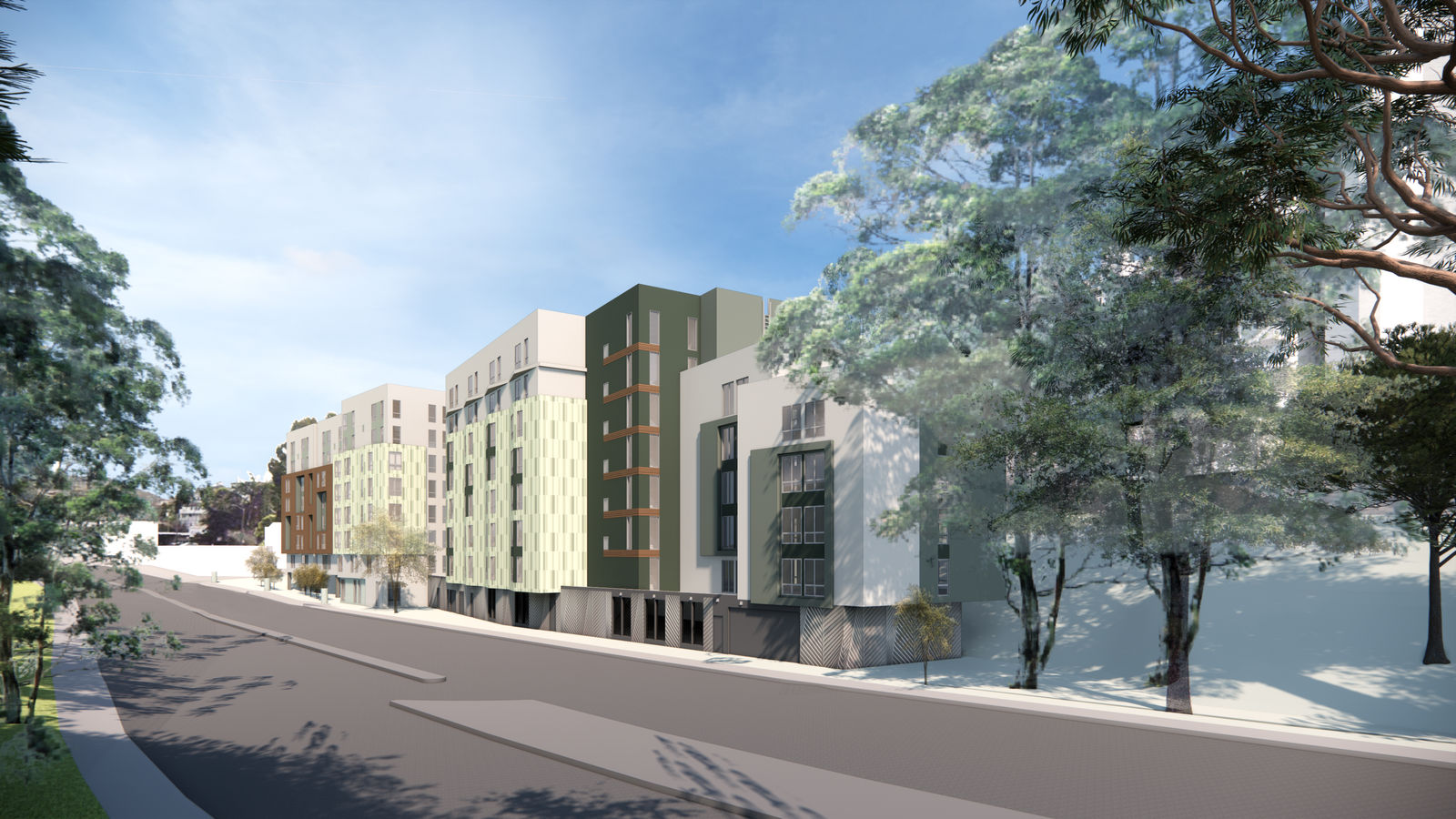
Mission Housing now presents an eight-story, 100% affordable family project; 25% of homes are intended for families exiting homelessness.
current proposalnot the 2016 design
Concept rendering and current program published by Mission Housing, 250 Laguna Honda, accessed Aug. 4, 2026. This is a later proposal; status and design can change.
Governance / myth audit26
Myth
“Residents still own and maintain all the streets.”
×
Fact
The city maintains the streets today.
Residents did take over substandard developer-built streets, sewers and lighting in 1918–19. San Francisco later assumed street and curb responsibility.
The association remains consequential. Its published materials document parcel assessments supporting the Maybeck clubhouse, trees/landscaping and events; its guidelines request review of exterior work.
Sources disagree on the handoff date: WNP says 1978; a local history ties a final assessment to 1984. Present-day responsibility is the secure fact.
2,2202020 population inside the SF Find Forest Hill polygon, block approximation
53.6median age in tract 304 ±4.7 years
81.9%owner-occupied in tract 304
$137kmedian household income ±$38k
31.8%
age 65+
47.8%
non-Hispanic Asian
31.0%
non-Hispanic White
Boundary warning: 93.7% of Forest Hill land lies in tract 304, but Forest Hill is only 49.5% of that tract. ACS tract values are a useful proxy—not a neighborhood census.
Documented past residents: Willie Mays, civil-rights lawyer/Supervisor Terry Francois, Governor Pat Brown, and Jerry Brown. Current private residents are omitted without strong public evidence.
White share fell. Asian share stayed large. Hispanic share rose.
White aloneAsian aloneHispanic, any race
White alone 56.7% → 52.5% → 45.9%Asian alone 37.3% → 40.3% → 39.6%Hispanic, any race 4.3% → 5.4% → 7.5%
Race-alone and Hispanic-origin series overlap. Tract population: 5,177 → 5,106 → 5,269. The tract boundary is effectively stable from 2010 to 2020; 2000 comparability is used with caution.
Median owner-occupied home value / nominal dollars
A persistent premium.
Tract 304 proxySan Francisco
*2010 tract median is censored at “$1,000,000 or more.” Tract 90% MOEs: 2015 ±$72.5k; 2020 ±$255.3k; 2024 ±$274.2k; 2010 unavailable. SF MOEs: ±$7.5k / $7.7k / $11.3k / $20.6k. Five-year windows overlap, and ACS changed within-window inflation adjustment beginning in 2022. Owner-reported value—not sale price or Zillow.
Method warning: reported incident rows are not victimization or an official UCR rate. Points are privacy-snapped; the neighborhood count is tiny and boundary-sensitive. Broad “assault” includes simple assault. Fixed 2020 population denominators are used for all three years.
The assessor dates the house to 1920—the year Lang Realty took over tract development; no property-specific Lang, architect or builder link is verified.
Bedroom conflict: the assessor field is zero—an evident missing/zero-coded value. 2024–25 rental ads describe two bedrooms plus a sunroom/office; large portals normalize the home as three bedrooms. This deck does not turn that disagreement into certainty.
CEQA status A · district-derivedCalifornia Register–eligible Forest Hill Historic Districtnot an individual landmark
The story-count mismatch likely reflects differing treatment of the lower garage/basement level; the record does not resolve it.
The 1999 Recorder document preserves the original subdivision description: parts of Lots 9 and 10, Block 6, Forest Hill map filed May 8, 1913.
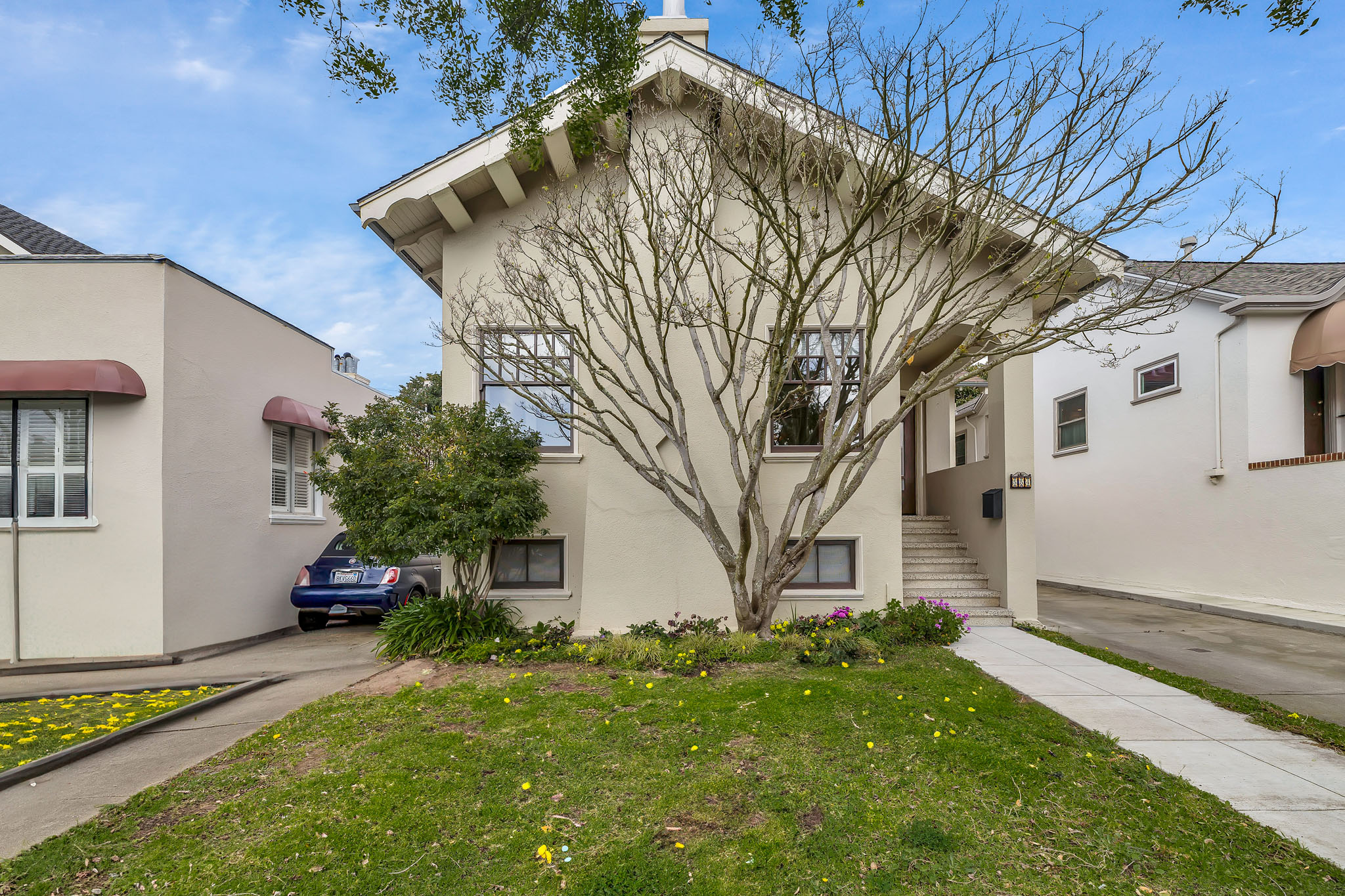
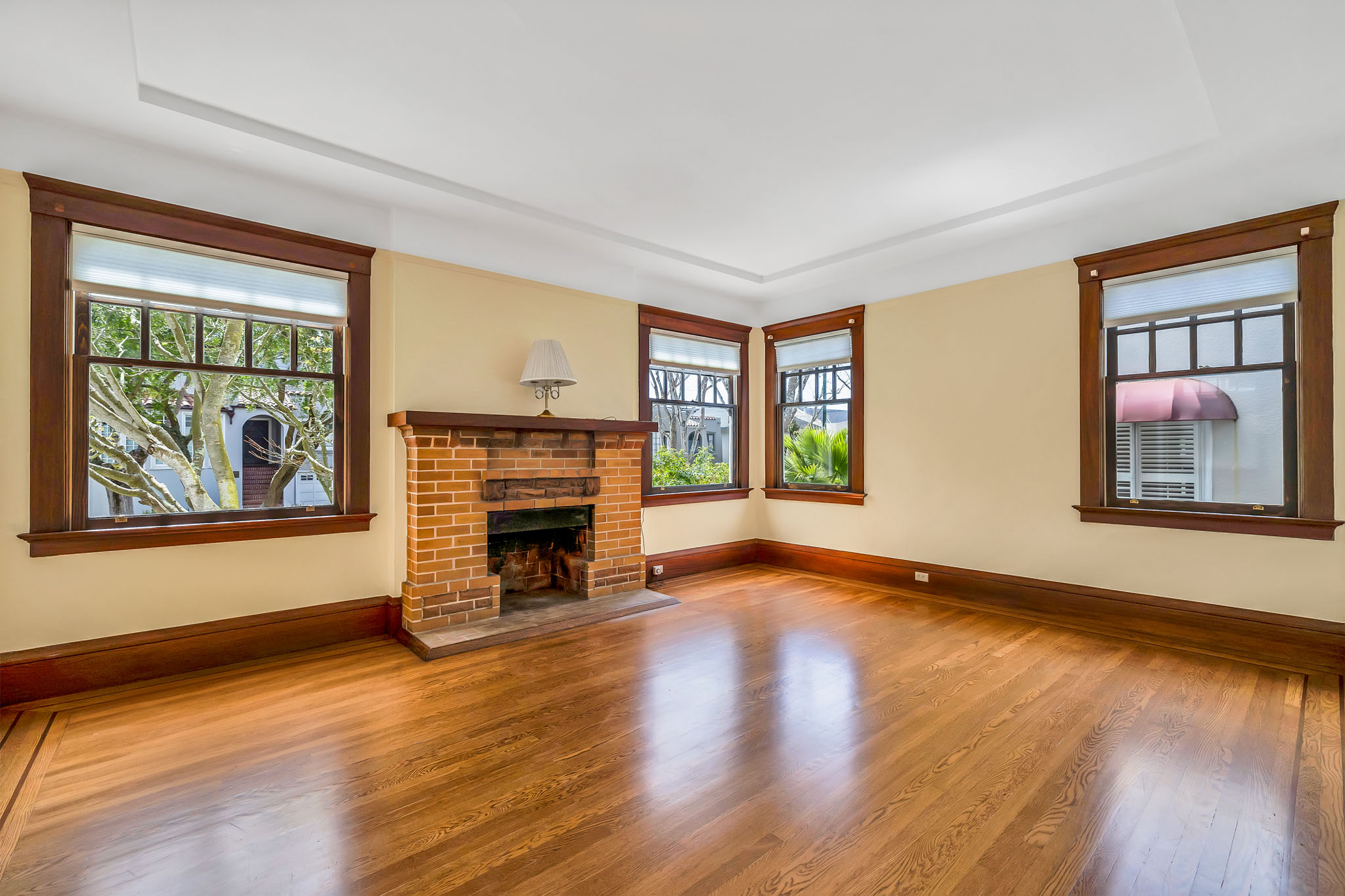
A Craftsman-influenced period house, adapted to a hill.
Front gable • stucco • broad eaves and rafter tails • raised main floor.
Living room: multi-light windows • dark wood trim • brick fireplace • coved/tray ceiling.
The visible evidence supports a front-gabled, Craftsman-influenced period house whose living floor appears lifted above garage/basement space. This is a medium-low-confidence visual interpretation. No verified architect or builder was found.
Images: RentSFNow/Veritas listing photographs, April 2025; photographer not identified; no reuse license found. Listing record. Style description is visual analysis, not an archival classification.
Biography of a house / 435
A century in records
The house leaves a thin—but real—paper trail.
The 1994/97 sewer permits were filed/issued; completion is not shown. Reroof #9611779 completed in 1996 ($14,316 estimated). Foundation bolting #201109124407 was issued in 2011 ($3,000), but completion is unconfirmed. Bath/partial kitchen #201206263470 completed in 2012 ($11,000 revised); electrical and plumbing companion records corroborate it.
No verified public price series was found for 554 Magellan.
The official Recorder resolves the confusion. A 1993 deed of trust secured a $160,000 loan—debt, not price. A 1999 quitclaim deed moved the same people’s interest into their revocable trust “WITHOUT CONSIDERATION,” with $0 transfer tax—not a sale.
No arm’s-length sale appears in the official online index from 1990 onward. Zillow and Redfin estimates are not sales. They stay off the chart.
Assessment is not price: the 2025 secured-roll assessed land + improvements total $90,726. That assessed figure is not a market valuation.
Official records: SF Assessor-Recorder, docs 1993423995 and 1999697225; search fact sheet. Assessment: DataSF. PropertyShark’s “last sold” label is contradicted by the official no-consideration deed. Zillow/Redfin estimates intentionally excluded.
Biography of a house / 637
The street becomes a room
Magellan Avenue / 1920s → 2025
1920s — Magellan near Marcela; young homes and open canopy. Photographer Unknown, Marilyn Blaisdell Collection / Courtesy of a Private Collector.
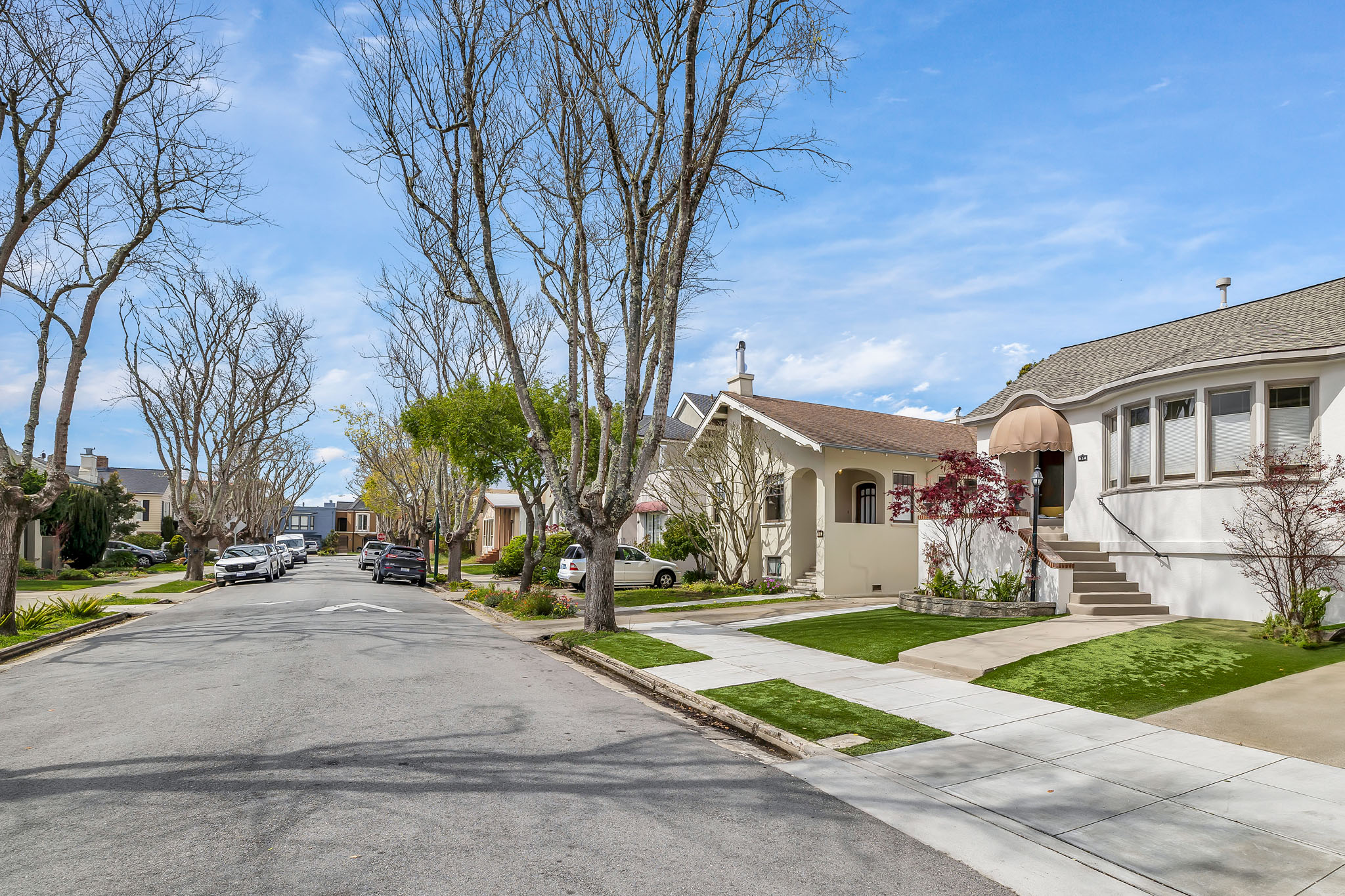
2025 — 554’s block; the street reads as a planted room. RentSFNow/Veritas; photographer not identified.
Same avenue, not the same block or matched vantage. SFPL indexes one exact-address assessor photo in Photo Box 52, Bundle 1038; no direct online scan was located, and none appears in PIM.
Archival image: Photographer Unknown (Marilyn Blaisdell Collection / Courtesy of a Private Collector), OpenSFHistory/WNP wnp37.03073. Current image: RentSFNow/Veritas, April 2025; photographer not identified; no reuse license found; listing record. Photo locator: SFPL.
The honest verdict38
The good / the bad / the ugly
All three are visible in the same streets.
The good
A coherent work of landscape urbanism
Rail access, mature canopy, humane curves, architectural texture, quiet streets and a rare neighborhood room by Maybeck.
The bad
Scarcity preserved as character
Low density, an older population, high owner occupancy, high values and weak interior commerce limit who can enter and how the neighborhood adapts.
The ugly
Exclusion was written into the product
Racial restrictions and some residents’ documented fear of formerly homeless neighbors are not footnotes. They are part of how “tranquility” was produced and defended.
Forest Hill deserves admiration precise enough to survive the truth.
Synthesis based on the cited historical, demographic, housing and property records throughout this deck.
Research audit39
What survived verification
Strong record
Neighborhood formation, tract controls, transit dates and advertised developer restriction language
554’s assessor facts, zoning, Sanborn footprint and seven permit records
Tract demographics/values and derived incident-rate method with stated boundaries
What remains genuinely missing
Open record
Architect / builder: not found in the accessible records reviewed
Acquisition / prices: no arm’s-length sale in the 1990–present online index; pre-1990 chain unresolved
Exact-address assessor photograph: indexed in SFPL Photo Box 52, Bundle 1038; view unknown and no online scan located
“Magellan” naming file: no authoritative naming record located
Also unresolved: the precise 1978/1984 street-transfer sequence; a parcel-level geotechnical study for 554; comprehensive pre-1980 permits; the pre-1990 acquisition deed/ownership chain; and a verified exact-address newspaper feature. These are research gaps—not invitations to infer.
See the companion research appendix for the records searched and practical next steps.